

Original Feishu Document · Source Revision 12
💡
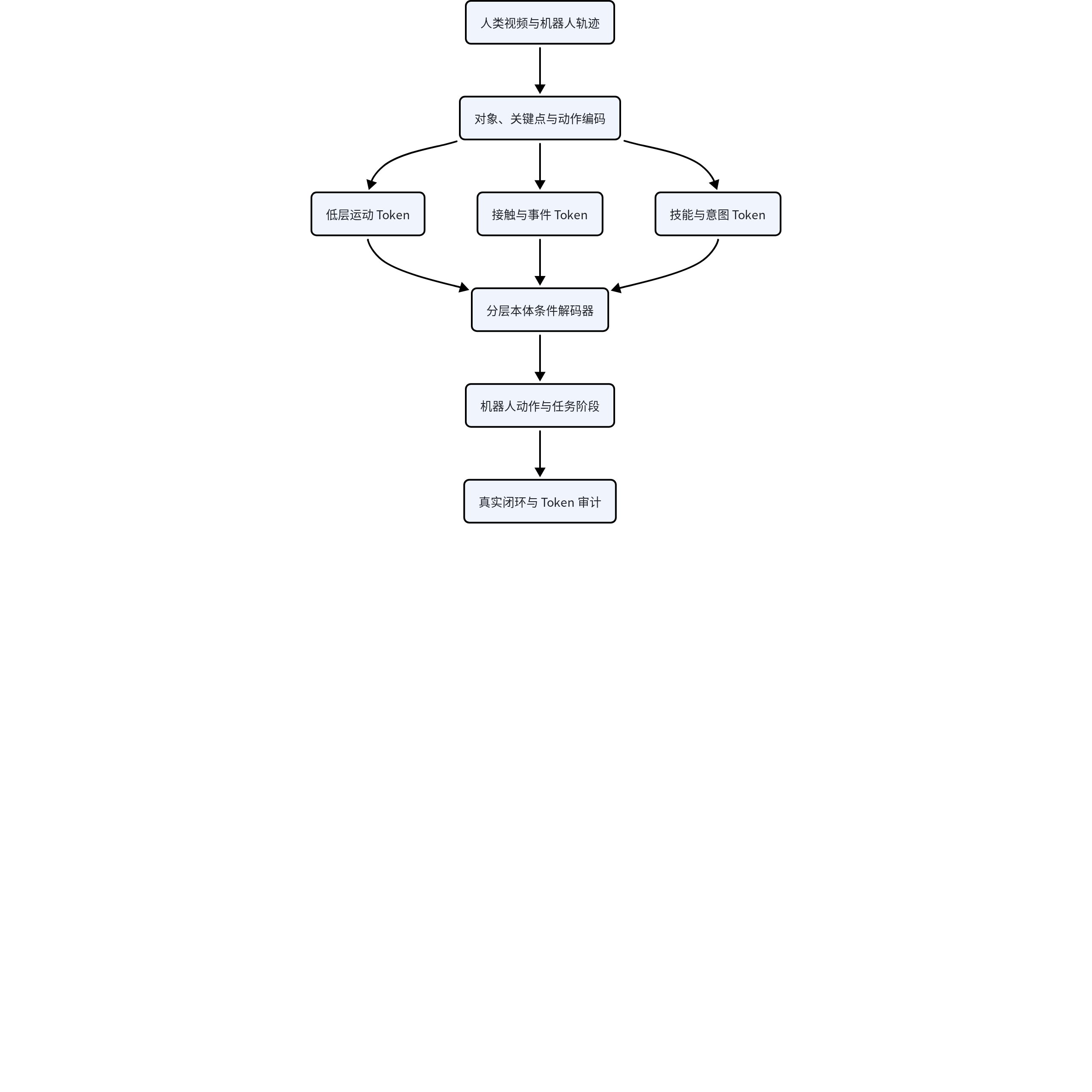
Mechanism Lesson: An action tokenizer compresses robot control, while a Behavior Tokenizer further aims to unify human videos, events, skills, and cross-embodiment behaviors. This lesson discusses token hierarchies, training objectives, codebooks, event boundaries, and robotic decoding.
Learning Objectives
After completing this lesson, you should be able to distinguish action tokens, event tokens, skill tokens, and intent tokens; derive the VQ objective; analyze codebook collapse; design hierarchical tokenizers and cross-embodiment decoding; and establish control-relevant evaluations.
1. Tokenizer Objectives
Encoding:
Interpretation: The tokenizer T encodes a continuous behavior trajectory tau into a token sequence of length M.
Derivation: A long trajectory contains high-frequency actions, event boundaries, and task structure. The encoder compresses this information into a shorter sequence. Whether this compression is useful depends not only on sequence length, but also on whether the tokens can be predicted, composed, and decoded by a robot.
Decoding:
Interpretation: Given a token sequence and embodiment identifier e, the decoder D reconstructs the behavior trajectory for that embodiment.
Derivation: Shared tokens should represent functions or events, while different robots realize the same function through different action spaces. Providing e to the decoder allows the high-level vocabulary to be shared while keeping low-level control embodiment-specific.
denotes the embodiment. A tokenizer must support compression, prediction, and reconstruction while preserving task, event, and control information.
2. Four Token Levels
| Level | Examples | Timescale |
|---|---|---|
| Low-level action | End-effector delta, joint change | Milliseconds to seconds |
| Motion primitive | Approach, lift, rotate | Seconds |
| Interaction event | Contact, secure grasp, release | Seconds |
| Skill/intent | Grasp a cup, open a drawer | Several seconds to minutes |
A single-level vocabulary struggles to represent both fine-grained actions and high-level composition. A hierarchical tokenizer better reflects the multiscale temporal structure of behavior.
3. Vector Quantization
A continuous encoding is mapped to the nearest code:
Interpretation: Select the codebook vector with the smallest Euclidean distance to the continuous encoding h, and denote its index by k star.
Derivation: Vector quantization uses nearest-neighbor assignment to partition a continuous space into discrete Voronoi regions. The region containing h determines the output token; the distance metric and encoding scale directly determine the semantics of the partition.
The VQ-VAE objective includes reconstruction, codebook, and commitment terms:
Interpretation: The VQ loss consists of a reconstruction term, a codebook term that pulls the nearest code toward the encoding, and a commitment term that encourages the encoding to remain close to the selected code.
Derivation: The second term applies stop-gradient to h and updates only e_{k^*}; the third term applies stop-gradient to the code and pushes only the encoder output toward that code. The reconstruction term ensures that the tokens preserve trajectory information, while beta controls how frequently the encoder jumps between code boundaries.
denotes stop-gradient.
4. Codebook Collapse
A small subset of tokens is used frequently while the remaining tokens are idle. Check:
- Usage rate and perplexity.
- Token entropy conditioned on task or embodiment.
- Duplicate codes and dead codes.
- Mutual information between tokens and events.
Expanding the codebook does not automatically add semantics and may merely increase the number of unused tokens.
5. Temporal Segmentation
| Segmentation Method | Advantages | Risks |
|---|---|---|
| Fixed window | Simple and parallelizable | Splits events |
| Velocity change | Captures motion boundaries | Jitter creates spurious boundaries |
| Contact event | Strong physical meaning | Requires sensing |
| Change-point detection | Data-driven | May not align with task semantics |
| Learned termination | End-to-end | Difficult to stabilize and interpret |
6. Training Objectives
In addition to reconstruction, the following can be used:
Interpretation: The total loss is a weighted sum of five objectives: reconstruction, prediction, contrastive learning, event-boundary detection, and cross-embodiment alignment.
Derivation: Reconstruction preserves details, prediction requires tokens to be useful for the future, the contrastive objective structures semantic neighborhoods, the event objective shapes temporal boundaries, and the alignment objective connects human and robot behavior. The lambda coefficients must be balanced according to downstream tasks and gradient scales rather than by optimizing only one offline metric.
- Predict the next token or future state.
- Enforce consistency for the same event across viewpoints.
- Apply supervision from event labels.
- Align human and robot behaviors.
- Incorporate task outcomes and value.
7. What Tokens Should Humans and Robots Share?
Share high-level events and object changes while preserving low-level embodiment differences. Shared tokens can be decoded with embodiment conditioning:
Interpretation: Given a shared behavior token, the current embodiment observation, and the embodiment identifier, the embodiment-conditioned decoder models the robot’s action.
Derivation: The same token corresponds to different joint commands on different bodies, so decoding must use the embodiment state. Fixing the token, replacing e, and training a small adapter on a held-out robot can test whether the vocabulary truly shares functional semantics.
If a shared vocabulary relies only on BPE co-occurrence statistics, it may share strings rather than behavioral semantics. Cross-embodiment retrieval and closed-loop decoding are essential.
8. Relationship Between FAST and the Behavior Tokenizer
FAST applies frequency-domain compression and BPE to continuous robot actions, with the goal of efficient autoregressive action modeling. The Behavior Tokenizer has a broader scope that also encompasses human videos, events, skills, and cross-embodiment semantics.
FAST can serve as the low-level action layer, while high-level behavior tokens provide event or skill conditioning.
9. Evaluation
| Layer | Metrics |
|---|---|
| Compression | Token length, entropy, perplexity |
| Reconstruction | Action, trajectory, and event errors |
| Prediction | Next token and future state |
| Semantics | Task, object, and phase probes |
| Transfer | Cross-embodiment retrieval and few-shot decoding |
| Control | Real-world success, smoothness, contact, and recovery |
10. Minimal Experiment: Do Tokens Preserve Task and Control Semantics?
On the same set of multistage manipulation trajectories, compare fixed-window tokens, event-based segmentation, VQ tokens, continuous latents, and hybrid discrete-continuous tokens. Hold encoder capacity, total bitrate, training data, and downstream policy constant.
Report trajectory reconstruction, future prediction, codebook perplexity, event-boundary F1, mutual information between tokens and object-state changes, cross-view retrieval, few-shot decoding on held-out robots, and real-world closed-loop success rate. Additionally, perform token permutation and freeze the action decoder to verify that the policy truly uses the tokens.
11. Exercises
- Derive the three VQ-VAE loss terms.
- Design diagnostics for token usage and codebook collapse.
- Compare fixed-window segmentation with contact-event segmentation.
- Design an experiment in which humans and robots share high-level tokens.
- Explain why FAST is not equivalent to a complete Behavior Tokenizer.
- Define a hybrid representation consisting of discrete skill tokens and continuous action parameters.
12. Primary Failure Modes
| Failure | Symptoms | Diagnosis and Correction |
|---|---|---|
| Codebook collapse | A small subset of tokens occupies the vast majority of trajectories | Measure usage and perplexity; reinitialize empty codes and use balanced sampling |
| Token fragmentation | Minor velocity differences split the same event into many tokens | Use event supervision, temporal consistency, and hierarchical tokens |
| Preserving only jitter | Reconstruction error is low, but object states and task phases are unpredictable | Add object, event, future-prediction, and control losses |
| Boundary misalignment | Tokens switch in the middle of contact or release, making skills non-composable | Evaluate event-boundary F1 and use hysteresis and variable-length segmentation |
| Illusory string sharing | Humans and robots use the same token IDs with different meanings | Use cross-embodiment retrieval, counterfactual permutation, and held-out embodiment decoding |
| Decoder ignores tokens | Actions barely change after token permutation | Use token interventions, conditional mutual information, and decoder-capacity controls |
| Unfair bitrate comparison | A method gains additional information capacity by using more tokens | Fix bits per step, sequence length, and compute budget |
13. Paper Facts, Author Interpretations, and Course Assessments
| Work | Paper Facts | Author Interpretation | Course Assessment |
|---|---|---|---|
| VQ-VAE | Learns discrete latent variables using a discrete codebook and reconstruction objective, with stop-gradient training | Discrete representations can connect continuous data with autoregressive sequence models | Provides the foundation for quantization, but whether the codes have behavioral semantics depends on the data, segmentation, and downstream objectives |
| FAST | Applies frequency-domain transforms and BPE compression to continuous robot actions, improving the efficiency of autoregressive VLA action modeling | More suitable action tokens can shorten sequences and improve training | FAST primarily addresses low-level robot action compression and is not equivalent to a complete Behavior Tokenizer spanning human videos, events, and skills |
| Genie | Learns discrete latent actions from video and uses them for interactive future generation | Discrete behavior variables can be discovered from videos without action labels | Visually controllable tokens do not automatically possess semantics suitable for robot control; adapters and closed-loop validation are still required |
| XSkill | Learns cross-embodiment skill representations across human and robot videos | Skill-level semantics can be shared across different bodies | Shared semantics must be demonstrated through event boundaries, held-out embodiments, and real-world decoding rather than embeddings alone |
14. Cross-Reading
E2|Latent Actions and Inverse Dynamics
E4|Cross-Embodiment Alignment and Heterogeneous Co-Training
A1|Action Representations and the FAST Tokenizer