

Original Feishu Document · Source Revision 9
💡
Mechanisms lesson: Multi-robot co-training is not simply zero-padding actions. Different embodiments have different kinematics, action interfaces, cameras, and control frequencies. This lesson examines shared representations, embodiment-conditioned adapters, normalization, data mixing, and evaluations of genuine cross-embodiment transfer.
Learning Objectives
After completing this lesson, you should be able to define embodiment; distinguish shared semantics from embodiment-specific control; construct a unified data schema and adapters; analyze data-mixture weights and negative transfer; and design leave-one-embodiment-out evaluations.
1. What Embodiment Includes
Embodiment is more than a robot ID. It also includes:
- Joint structure, degrees of freedom, and workspace.
- End effectors and grasp geometry.
- Action interfaces, units, and control frequencies.
- Cameras, force sensing, and tactile sensing.
- Low-level controllers and safety constraints.
The policy can be written as:
Interpretation: The action for embodiment e is sampled from a shared policy distribution conditioned on the observations, task goal, and embodiment description for that embodiment.
Derivation: Different robots have different observation dimensions and action spaces. Explicit conditioning on e informs the shared backbone of the current kinematics, actuators, and control interface. Input and output adapters perform shape conversion, while the shared backbone captures transferable semantics.
2. What Information Can Be Shared
| Shared | Embodiment-specific |
|---|---|
| Objects, tasks, and language | Joints and action dimensions |
| Object-relative poses | Reachability and singular configurations |
| Contact, stable-grasp, and release events | Gripper geometry and force range |
| Skill sequences | Control frequency and latency |
| Visual scene representations | Camera layout and calibration |
3. Adapter Architecture
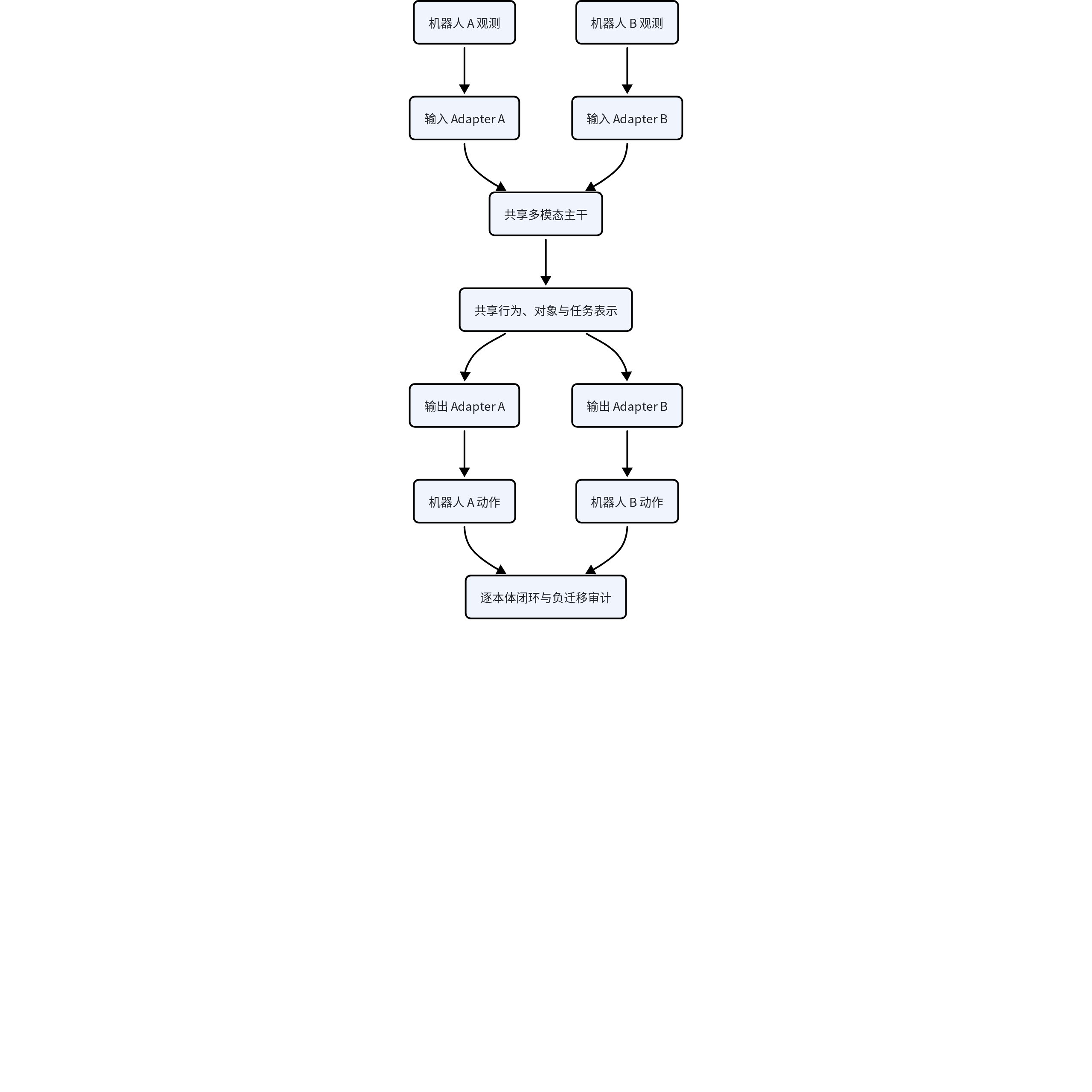
The input adapter aligns embodiment states and viewpoints, while the output adapter decodes the shared behavior representation into embodiment-specific actions. The degree of sharing is an empirical question; it is not automatically guaranteed by the name of the architecture.
4. Action Normalization
A common normalization method is:
Interpretation: Subtract the mean for embodiment e from its j-th action dimension, then divide by the standard deviation to obtain the standardized action.
Derivation: Computing the mean and scale separately for each embodiment prevents large-magnitude actions from dominating the gradients and keeps the training ranges of different dimensions comparable. However, z-score normalization aligns only numerical distributions; it does not align directions, units, control frequencies, or task functions.
Quantile-based scaling is another option. Normalization makes numerical ranges similar, but it does not align action functions. At different control frequencies, the same numerical value produces different displacements, so must be recorded.
5. Object-Centric Actions
The end-effector motion relative to an object is:
Interpretation: The end-effector pose in the object frame at time t equals the inverse of the object's pose in the world frame multiplied by the end-effector pose in the world frame.
Derivation: First, use the inverse of the object pose to transform from the world frame into the object frame, and then compose it with the world-to-end-effector transform to obtain the relative pose from the object to the end effector. The change in this pose between adjacent time steps can serve as an object-centric action shared across embodiments.
This representation is easier to share across embodiments than joint-space actions and can be executed by each robot through its own inverse kinematics and controller. Its drawbacks are the dependence on object-state estimation and reachability.
6. Data Mixing
The overall loss is:
Interpretation: The overall loss is the weighted sum of the expected losses over the data distribution of each embodiment, where all weights are nonnegative and sum to one.
Derivation: Mixed training is equivalent to first selecting an embodiment according to w_e and then sampling data from that embodiment. Setting weights according to sample count biases training toward data-rich embodiments, whereas uniform weights may amplify low-quality data. The weights must therefore be reported alongside ablations of target embodiment, task coverage, and data quality.
Mixing in proportion to sample count allows data-rich embodiments to dominate, while equal weighting across embodiments may oversample low-quality data. Weights can be based on task, quality, difficulty, and relevance to the target embodiment.
7. Positive and Negative Transfer
| Phenomenon | Cause | Check |
|---|---|---|
| Positive transfer | Shared object and task structure | Improvement on the target embodiment with few-shot data |
| Negative transfer | Conflicting actions and viewpoints | Single-embodiment training vs. co-training |
| Capacity competition | Insufficient shared-backbone capacity | Model scale and routing |
| Data shortcut | Identifying the embodiment from the camera | Viewpoint swapping and embodiment interventions |
| Spurious generalization | Target embodiment included in pretraining | Rigorous data audit |
8. Embodiment Conditioning and Routing
Explicitly including allows the model to learn a conditional policy. A Mixture-of-Experts model can route by embodiment or task. Excessively strong routing creates multiple independent models and eliminates sharing, while insufficient specialization leads to interference.
9. Human–Robot Alignment
Humans do not share the same action space as robots, but alignment can be established through:
- Object-relative motion.
- Event and skill tokens.
- Visual subgoals.
- Latent actions.
- Language intent.
Human data is suitable for sharing high-level knowledge and representations, while robot data grounds them in real control.
10. Evaluation
- Leave-one-embodiment-out evaluation.
- Few-shot learning curves for the target embodiment.
- Novel task compositions and novel objects.
- Camera-swapping and action-adapter ablations.
- Comparisons among single-embodiment, co-trained, and routed models.
- Controls for data quantity, quality, and weighting.
- Closed-loop evaluation on real robots rather than offline action error.
11. Minimal Experiment: Does Co-Training Produce Genuine Cross-Embodiment Transfer?
Select three training robots and one completely held-out target robot. Standardize task semantics and object sets while retaining differences in degrees of freedom, cameras, end effectors, action spaces, and control frequencies. Compare single-embodiment training, action zero-padding, z-score co-training, a shared backbone with adapters, object-centric actions, and embodiment-routed models.
Hold the total data volume, amount of few-shot target-robot data, backbone capacity, and inference budget fixed. Report zero-shot and few-shot success rates, negative transfer, per-embodiment performance, performance on unseen task compositions, object-centric action error, adapter parameter counts, and real-world closed-loop results.
12. Exercises
- Define a complete embodiment schema.
- Explain why action z-scoring cannot achieve semantic alignment.
- Design shared object-centric actions for two robotic arms.
- Construct a negative-transfer experiment.
- Design a leave-one-robot-out data audit.
- Explain how to perform causal ablations of heterogeneous co-training in π0.5.
13. Major Failure Modes
| Failure | Symptom | Diagnosis and Correction |
|---|---|---|
| False alignment through action zero-padding | Tensor dimensions are standardized, but the same dimensions have different semantics across robots | Use an explicit schema, adapters, and object-centric actions |
| Omitted control frequency | Identical normalized actions produce different physical displacements | Record Delta t, the action integration method, and the controller |
| Dominance by large embodiments | Overall average performance improves while performance on data-scarce robots declines | Report per-embodiment results and ablate weights and gradient contributions |
| Negative transfer | Adding heterogeneous data makes the target robot perform worse than training it alone | Examine task similarity, routing, adapter capacity, and conflicting gradients |
| Complete routing fragmentation | The MoE forms an independent model for each robot and provides no benefit from sharing | Analyze expert usage, ablate shared layers, and evaluate transfer to held-out embodiments |
| Object-centric state error | Relative actions that should theoretically be shareable fail because of pose-estimation errors | Improve calibration and account for object-pose confidence and reachability |
| Data leakage | Tasks or scenes from the held-out robot are duplicated in data from other embodiments | Deduplicate at four levels: task, object, scene, and embodiment |
14. Paper Facts, Authors' Interpretations, and Course Assessments
| Work | Paper Facts | Authors' Interpretation | Course Assessment |
|---|---|---|---|
| Open X-Embodiment / RT-X | Aggregates multi-robot data, trains cross-embodiment models using a unified format, and evaluates transfer | Data scale and heterogeneous co-training can produce general-purpose robotic capabilities | The contributions of data scale, task coverage, and embodiment transfer must be separated; per-embodiment results are more important than the overall average |
| Octo | Trains an open-source generalist policy on Open X data and supports fine-tuning with a small amount of target data | A generalist pretrained policy can rapidly adapt to new robots and tasks | Adaptation gains come jointly from visual semantics, task data, and the action interface, and must be disentangled through adapter and data-volume ablations |
| π0.5 | Connects high-level semantics with actions from multiple robot types through heterogeneous co-training, improving open-world generalization | Richer data and knowledge transfer can scale general-purpose robot policies | Transfer should be demonstrated with held-out embodiments, held-out tasks, and equal amounts of target data, rather than only by comparing against models trained on less total data |
| XSkill | Learns cross-embodiment skill representations from human and robot videos | Skills at the functional level can be shared across bodies | Real-robot decoding, event consistency, and negative-transfer audits are required |